
West Sussex & Brighton & Hove Age UK have opened a new hub in Brighton & Hove. Situated on 95 Queens Road, near Brighton Station, it is hoped the new hub will provide the older population in the city with better information and advice, including money advice, cost of living, fitness tips and how to stay safe from scams and more! Residents can pop in anytime on weekdays from 9.30 until 16.00. For more information, please go to: https://linktr.ee/aukwsbh_brightonhove or contact them at: www.ageukwsbh.org.uk or 0800019 1310
Logs brought into B&H kill precious elms
The Ride update
Please note that The Ride, on the southern end of Preston Park will be resurfaced and lines re-marked from 8am on Wednesday 25th September until 5pm on Friday 27th September. The Ride will be closed during this period.
The Gilded Elm is shortlisted for an award

We are very excited and pleased to let you know that The Gilded Elm (2023) has been shortlisted for the 2024 PSSA Marsh Award for Excellence in Public Sculpture – alongside works by Larry Achiampong & David Blandy, Nick Hornby, Tom Shaw and Yinka Shonibare CBE RA.
Please VOTE at the following website by scrolling to the bottom of the page https://pssauk.org/awards/
To read more about The Gilded Elm please visit https://elpidahv.art/works/the-gilded-elm/
The project has been funded by the National Lottery through Arts Council England, South Downs National Park Authority, Pride Social Impact Fund, Jeremy Knights & Co and supported by Brighton & Hove City Council. Critical support has also been received by several businesses, the most important of which are Brewers Decorators Centres, Repair Care, Connick Tree Care, Amazon Access Solutions, Gold Leaf Supplies, DP Squared Ltd, the artists agency and Yates.
FoPP walk with Alan Griffiths
Friends of Preston Park (FoPP) were pleased to welcome back Alan Griffiths for what has become an annual walk around the park sharing his in-depth knowledge of the horticultural history of Preston Park, captured over 40 years in his capacity as Operations Manager (his final role for CityParks).
The gathered group was treated at the outset to a wonderful view of the Rose Garden, still with many blooms, under a low Autumn sun and with a beautifully clear full rainbow to the east. Alan explained the transition of the rose garden planting from the original floribundas and traditional tea roses to the scented shrub roses in proliferation today. The huge contribution from David Austin roses throughout the years and continuing today was much appreciated by the group.
We walked around the formal garden admiring the current blooms and discussing the herbaceous beds along the borders. During Alan’s early years at CityParks there was an entire team of gardeners for the Rose Garden and a dedicated head gardener keeping the borders weed-free and the significant yew hedges perfectly trimmed. Our FOPP team talked the group through our upcoming plans to clear the borders and replace weeds with plants from our new propagating bench.


As the walk continued towards the tennis courts Alan told us about the grandeur of the bowling matches in Preston Park and reminisced about arriving very early in the morning to mow the greens in preparation. He indicated the layout of the five bowling greens and the separate changing pavilions for gentlemen and lady players! These are currently used by the FitnessHub gym and Woopsadaisy.

The group was very interested to hear about the use of the Winterbourne underground stream to water the park over the years, particularly in feeding the Rotunda pond. Alan pointed out the positions of the spring and the pumping gear.
Alan described the range of trees planted along the western edge of the park, selected and grown in the Stanmer nurseries and watered in from a truck carrying the stream water. We admired the newly planted UTFC trees, particularly the hawthorn currently laden with berries, which complement the existing varieties and are replacing some trees lost to elm disease and ash dieback. These trees are watered more efficiently these days with the aid of plastic water bags attached to their lower trunks.
The walk finished, as the sun set behind The Rockery with Alan reminding us how the remaining twin elm has observed centuries of development and change in the park, including the transition of its twin into its present gold and black statuesque form.

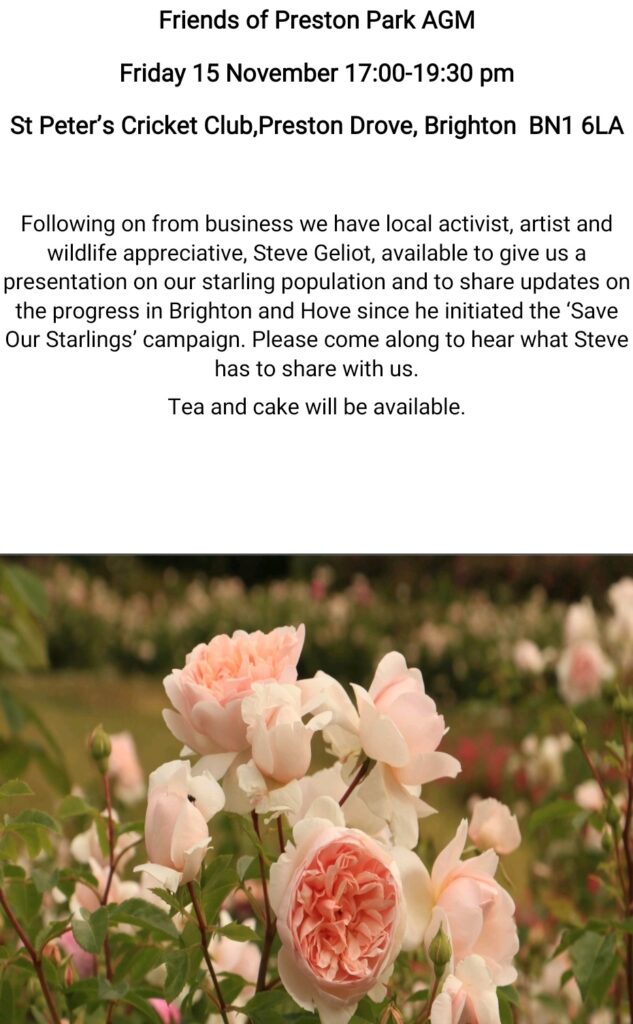
FoPP AGM, 15 Nov 2024
Preston Park walk with Alan Griffiths
Remember to get your tickets for next week’s Preston Park walk with Alan Griffiths, former City parks manager, on Thursday 12 September starting at 6pm.
Preston Park Outdoor Gym Update
The new outdoor gym for Preston Park is currently being installed on one of the old ex-bowling greens. It is hoped that it will be complete by the end of September. The space will be fully inclusive and accessible for all adult residents. Users can use a QR code to find out information on how to use particular pieces of equipment and there will be a free floor space to do non equipment exercise. The gym ground surface should enable its use in all weathers if needed.
We hope residents will enjoy sharing the space respectfully and encourage everyone to come and give it a try.


Preston Park tree walk with Alister Peters
On a sunny afternoon this week, around 20 people were led by Alister Peters, expert arborist, on a very interesting and enjoyable walk around many of the different trees in Preston Park.

In much of Brighton, sycamores and elms are the only large trees that can withstand the chalky soils and salty air. However, Preston Park is some distance from the sea and in a valley with more fertile soils, so enabling a wide variety of trees to flourish. Alister showed us how to identify a selection of them.


The walk began at the Rotunda Café, where a clump of trees includes a purple-leafed plum that is often mistaken for a copper beech. (Both copper and common beeches are also growing in the park.) We then walked across the grass behind the café to look at elms, a red horse chestnut, common and black walnut trees, and a sweetgum that is particularly beautiful in the autumn when its leaves turn red and purple. In the area around the Tile House, we looked at hornbeams, a dawn redwood (a deciduous conifer), a larch, a Turkish hazel, and two trees that are easy to confuse – a purple maple and a purple sycamore.
Among the other trees was a sycamore whose trunk was covered with ivy. But, as Alister explained, this is not a parasitic plant and it benefits insects and birds, so it needs to be managed rather than removed. By contrast, the mistletoe attached to a silver maple opposite the Chalet Café is parasitic.
There are numerous different types of elm in the park, some of which have been bred to be resistant to the elm disease that has destroyed millions of elms in the UK over the last 50 years. Very sadly, the disease is now destroying trees in Preston Park and elsewhere in Brighton & Hove, as is ash dieback. However, one of the ‘Preston Twins’, an English elm planted in the early 17th century, has so far survived. Another survivor is the Chinese elm in the Coronation Garden. Almost totally destroyed by the great storm of 1987, it is now a large tree with an impressive witch’s broom.
The walk ended at the gilded sculpture created from the Preston Twin that succumbed to elm disease in 2019. But all around us were trees, such as an Indian bean tree, a flowering magnolia, and a fruit-laden black mulberry tree in the Walled Garden, that are flourishing – and, happily for us, will continue to do so in the future.
The next FoPP event will be a walk in the park with former CityParks manager, Alan Griffiths on Thursday, 12 September. Please sign up on Eventbrite via the FoPP website if you would like to attend and hear what Alan has to say
Assault in Preston Park Rose Garden
Dear Members
This week a gardening volunteer was assaulted in the Preston Park Rose Garden by a member of the public because she had politely asked the woman to put her dog on a lead whilst walking through the Rose Garden.
Week in, week out, we have fantastic volunteers who turn up to help keep the park looking as lovely as we can. They do this for the love of the park, often in terrible weather. However, it has been noticed that there has been a recent increase of dog excrement in the Rose Garden as well as the removal of signs asking dog owners to keep their dogs on a lead whilst walking through the Rose Garden.
Please can we ask that those who refuse to listen to our polite demands, rethink what we are asking?
We are only asking for dogs on a lead in this small part of the park. It is very unpleasant and unhealthy for volunteers to have to work in close contact with dog excrement and urine. As well as this, dogs and children can do quite a lot of damage to the roses if they are not monitored. This is the one part of the park where ball games for dogs and children is inappropriate. The rest of the park is perfect for ball games.
However, and just to be clear, we are not suggesting that we don’t want dogs or children in the Rose Garden, but we are asking for more respect for the garden and for the volunteers. Preston Park is the People’s Park. It is for all citizens to use and we therefore ask everyone to be kinder and more respectful in their day to day use of this very busy and much loved public space.
Thank you, FoPP Committee